
Predicting what happens to a profession is a poor use of anyone’s time, and I have some standing to say so. During the first internet boom, I was developing and teaching online technology at postgraduate level, chairing a new media laboratory that led online journalism across a continent, and presenting an annual conference on where the internet was taking us. Very little of what any of us said with confidence turned out to be right, in either direction. The enthusiasts and the sceptics were wrong about roughly the same amount.
What that period did teach me is which questions are worth holding. Not what a technology will do, which is unknowable, but what it changes about the conditions people develop and struggle and recover in. Those are the questions below.
Artificial Intelligence in the Room
Start with what is already working. The use of artificial intelligence by clients is the most recent version of a decade-long shift toward people arriving already informed, and I have embraced it rather than resisted it.
Clients use AI chats to understand themselves and their symptoms, to track those symptoms over time, and to challenge their own thinking. Where a client brings that usage into the session and we work out plans and strategies together, it supports their therapeutic growth. Where the therapist and the client are both using it consciously and thoughtfully, and checking in with each other regularly, it is useful. The condition in that sentence is the whole of it. AI used inside a therapeutic relationship is a different object from AI used instead of one.
From Tool to Pseudo Therapist
That distinction will not hold on its own. Artificial intelligence will move from being a research tool and a means of self-understanding to functioning as a pseudo therapist, and the shift is already underway.
The profession’s instinct is to disapprove. Every previous instance of a profession declining to engage with a technology its users had already adopted ended the same way, with the profession losing the argument and the standards going with it. The useful question is not whether people should be doing this. They are doing it. The question is what a therapist does with a client who arrives having already had a version of the conversation, at three in the morning, with something that agreed with them.
Some of that will be workable material. Some of it will be a relationship the person has formed with a system optimised to be agreeable, which is not a neutral thing to bring into therapy.
The Smartphone Argument, Properly Stated
The public argument about smartphones and adolescent mental health has been conducted poorly from both directions, and clinicians are being asked to take positions in it constantly.

The strong claim, that phones and social media caused a generational collapse in adolescent mental health, runs ahead of the evidence, and the researchers who have said so are right about the methodology. The counter-position, that the effects are too small to matter, mistakes a modest average effect across a universally exposed population for a modest problem.
What survives the argument is narrower and considerably more useful. General screen time predicts very little. Problematic use, meaning compulsive patterns with withdrawal-like features, predicts a good deal. Passive consumption is worse than active. Sleep displacement is the mechanism with the most consistent support, and it is displacement rather than blue light doing the work. School phone restrictions show reasonably consistent academic gains and much weaker effects on wellbeing, largely because they do not change total daily use. And the risk concentrates in adolescents who are already vulnerable.
None of that supports a moral panic. All of it supports asking a different set of questions in assessment than the profession was asking ten years ago.
Growing Up Inside It
My concern about artificial intelligence is a different order of concern, and it is developmental rather than epidemiological. Everything above concerns people who acquired these tools after their development was finished. The harder question is what happens to those who do not.
The first is problem solving and critical thinking. The skill in solving a problem is not the arrival at an answer. It is the capacity to stay inside an unresolved state long enough for thinking to do its work. Significantly reducing the need for a young person to tolerate the messy middle of an unresolved issue and then to build their own way out does not provide the mechanisms to develop emotional resilience, tolerance of uncertainty and systematic critical problem solving.
The second follows from it. There is a developmental window in which neocortical capacity is built, and in which the ability to activate that capacity under emotional load is established. Both depend on repeated demand. If the demand is consistently met by an external system before the young person has to meet it themselves, I do not assume the window simply stays open and waits.
The third is emotional independence and agency. Distress that is always immediately answered, always articulated back in better words than the young person could find themselves, and always soothed on request, is distress the person never learns they can survive under their own management.
The consequence of all three is an exaggerated external locus of control: a young adult who can describe their own psychology fluently, in borrowed vocabulary, and does not believe they are the agent of it.
This is a clinical hypothesis and not a finding. The research to test it does not exist and will not for a decade. What exists now points the same way without settling anything: early work on relational displacement, where adolescents substitute AI conversations for the difficult human ones through which relational skill is built, and a growing literature on cognitive offloading in which heavier reliance on AI tracks with weaker performance on exactly the higher-order tasks being delegated. The clearest signal comes from adults rather than children, where clinicians using AI diagnostic support show measurable decline in unaided performance within months. Capability delegated appears to be capability lost, in people who had fully developed it.
I am conscious of having watched an earlier generation of confident predictions fail in both directions, and I hold this one accordingly. But the argument for waiting for the evidence is an argument for waiting through the childhoods in question.
What Happens to Supervision
Supervision is the profession’s actual quality mechanism. Not training, which ends, and not registration, which is a threshold rather than a practice. Supervision is where clinical judgement is examined by someone else on a continuing basis, and it is the reason a practitioner’s work in year fifteen differs from their work in year two.
It is also expensive, unbillable and invisible to clients, which makes it the first thing a volume-driven delivery model treats as overhead. A profession moving toward platform employment, lower entry thresholds and shorter interventions is a profession under pressure to thin out the one mechanism that catches its errors. I would watch this more closely than anything happening to the technology.
What Clients Will Assume About Privacy
Confidentiality has been the profession’s foundational promise, and the conditions supporting it have quietly changed. Sessions run over commercial platforms. Notes sit in cloud systems. Clients arrive having discussed their difficulties in detail with consumer products whose data practices they have not read and whose retention policies they could not describe.
The next decade will produce an incident significant enough to force the question, and the profession will be better placed if it has thought about it beforehand. There is also a clinical dimension that gets less attention: what a person will disclose depends on what they believe about where it goes. If clients come to assume that everything said anywhere is retained and analysed somewhere, that assumption will be in the room whether or not it is accurate.
The Economics of Specialist Practice
Small specialist practices are being squeezed from both directions. Underneath sits venture-funded volume provision at a price point no specialist practice can match. Above sit rising costs of supervision, insurance, training and the administrative load of regulated practice. On the client side, therapy has become discretionary spending for many households.
The specialist middle is the part of the system most easily lost, and it is where complex, long-term and unusual presentations are actually held. Nobody is planning its disappearance. It will simply not be anybody’s job to prevent it.
Where Classification Goes Next
Classification is moving toward dimensional models, and personality disorder has already made that move in ICD-11. The intellectual case is sound. Personality difficulty was never a set of discrete categories.
The question for the next decade is what a dimensional system does when it meets a rationing system. Severity gradings can be used to describe a person or to sort them, and services under pressure will use them to sort. A model that could have made visible the large group whose difficulties are serious, persistent and below the categorical threshold can just as easily give that group a number and a reason to decline them. Which of those happens is not a scientific question and will not be settled by the research.
The Gap That Has Not Closed
If the first port of call becomes an AI and the second a platform, the question of what specialist practice is for becomes sharper rather than softer.
The people this practice opened for in 2016 are the same people least well served by both. Those whose personality structure makes treatment as usual ineffective or actively harmful. Those whose cognitive profile has never fitted the standard protocol. Those who sit far enough outside the normative picture that a general service cannot see them, including the overlaps that get least attention: some notable examples include men with eating disorders, male survivors of sexual assault, non-normative relationship structures, and the people sitting in more than one of these at once.
Ten years on, that gap has not closed. Accessible provision expanded considerably and specialist provision did not, so in relative terms the gap is wider than when we started.
The Positions Worth Holding
Predictions are cheap. Positions can be argued with, so they are worth stating plainly.
On Technology
Neither adoption nor refusal is a position. Whether clients use these tools is settled; they do. The choice available to the profession is whether that use happens inside a professional relationship where it can be examined, or outside one where it cannot. I have taken the first option with my own clients and it works.
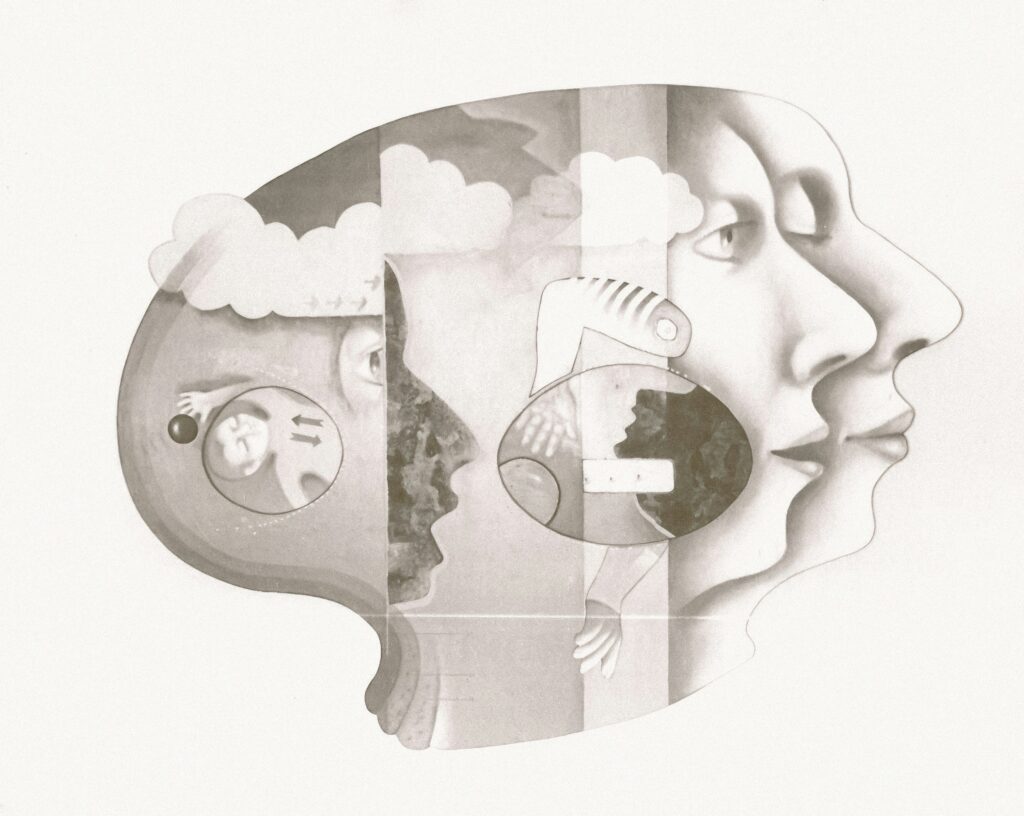
That judgement does not transfer to children. What is a convenience to someone whose development is complete may be formative for someone whose development is not, and the field keeps making one judgement where two are needed. Adult clients using AI to think with is a clinical opportunity. Adolescents outsourcing the tolerance of unresolved states during the years in which that tolerance is built is a different matter, and the absence of evidence is a reason for caution rather than permission.
The technology is also not the main event, which the last decade should have taught us. Delivery moved onto a screen and the profession adapted inside three years. The questions that went unsettled over that decade were never technological ones.
On the Client
Everything that can be delegated is being delegated, and that clarifies what cannot. Information can be supplied by a search engine. Reflection can be simulated by a model. Availability at three in the morning is something no practitioner offers and no client should have to do without.
What none of it provides is a relationship that does not comply. A system optimised for agreement cannot deliver the experience of not being agreed with by someone who stays anyway. That experience is most of the work with the clients I see and the whole of it with some of them. As the informational functions of therapy are absorbed elsewhere, what remains is the relational core, which is what the work always was and which the standardising models were already treating as incidental.
The client is also not a unit of one. The person arrives alone, the formulation is built around them, the work is theirs and the outcome is measured on them. A decade of working with people held at the margins has shown repeatedly that the person in the centre of the storm is held inside a family, a community and a culture, and that when direct work with that person is not possible or not the best option available, work with the people around them is not a consolation prize. It is frequently the intervention. That is not a new idea. It is an old one that individualistic therapy culture and individualistic funding models have made easy to forget.
On the Field
The last decade expanded access and thinned expertise, and treated those as unrelated developments. They are not. A profession that cannot say what its practitioners are qualified to do, that leaves two of its principal titles unprotected, that treats supervision as overhead and that is losing its specialist middle to platform economics has not made a decision about any of this. It has allowed separate pressures to produce an outcome nobody chose and nobody is accountable for.
The question underneath all of it is whether accessibility and depth are a trade-off or two things that both have to be built. They are currently being managed as a trade-off, and the people who lose that trade are consistent: complex, marginal, expensive to treat and small in number. A field willing to say that out loud would be in a better position to argue for the funding, the training routes and the protected titles that would change it.
What I Would Hold To
None of this is a prediction. Technology will do what it does, and I have been wrong about it before, publicly and in print. What I would hold to is narrower: that the value of this work sits in the relationship rather than in the information, that the people least served by a standardising system are the ones most in need of a service that refuses to standardise, and that a profession is judged on who it can hold rather than on how many it can process. We opened in 2016 for the people at the edge of the storm. Whatever the next ten years bring, that edge will still be there, and so will they.
Storms Edge Therapy is a private psychological practice working with adults across the UK and internationally. Our team of clinical and counselling psychologists offers support for a wide range of individual and relational challenges. To find out more or to book an initial consultation, get in touch.
Frequently Asked Questions
I have been using AI to work through my own difficulties. Is that a problem?
On its own, no, and for a good many people it is useful. What matters is whether it sits alongside a relationship in which what you arrive at can be tested, or whether it has quietly become the only place the thinking happens. A model will rarely tell you that the frame you brought it is the wrong frame, and that is often the part that needs saying.
How would I know whether I need a specialist rather than a general therapist or an online platform?
The most reliable indicator is history rather than severity. If you have been through two or three pieces of therapy that started well and stalled in the same place, or that ended with you feeling harder to help than when you began, that pattern is worth taking seriously as information about fit rather than about you.
Should I stop my teenager using AI?
The developmental concerns set out above are a clinical hypothesis and not a settled finding, and a blanket prohibition is unlikely to be either enforceable or useful. The more workable question is whether they still encounter problems they have to sit with unsolved, distress they manage without immediate assistance, and conversations that are difficult because another person is genuinely in them.